
Handheld laser welding has moved out of the robot cell and onto the bench. In job shops and fabricators across the US and Europe, welders now pick up a torch with a fiber-delivered beam instead of a TIG or MIG gun — not because the beam is new, but because the equipment became affordable and portable enough to hand to a skilled welder. Where handheld laser welding pays off is specific: thin to medium sheet, cosmetic seams, complicated geometries, and small lots that never justified a robot.
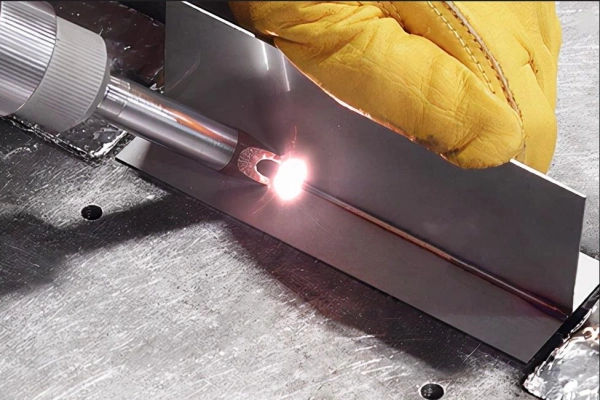
The important caveat comes from the industry itself. As Oliver Würth, Technical Expert for Welding and Cutting at Air Liquide, puts it, handheld laser welding “does not replace traditional techniques such as TIG or MAG welding in many workshops, but complements them” (All-About-Industries, 2025). That framing matters: it tells you handheld laser welding is a capability you add for a class of work, not a machine you buy to retire your other welders.
What Handheld Laser Welding Actually Is — and Isn’t
A handheld laser welding system delivers a focused beam through a fiber optic cable to a torch the operator guides by hand. Because the raw spot is very narrow, the optics inside the torch move the beam side to side automatically — a technique called wobble — to create a usable seam width, according to the parameter guide published by IPG’s LightWELD team (LightWELD). Filler wire is optional: handheld laser welding can run autogenously, or with standard MIG wire where gaps need filling.
What it is not: an unskilled process. “It’s not for beginners,” says Stephan Berekoven, a DVS welding specialist whose company holds TÜV certification for laser beam welding — his operators completed intensive training because hand-guided work is about dexterity as much as equipment. Budget for training before you budget for the second machine.
What Handheld Laser Welding Replaces on the Shop Floor
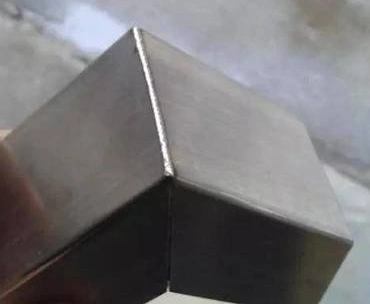
In practice, shops reach for handheld laser welding in four situations:
- Thin stainless and fine sheet work — railings, guards, panels, envelopes, and enclosures where a wide arc seam would distort or discolour the part.
- Cosmetic and near-finished joints — where the goal is to avoid grinding, polishing, and rework altogether.
- Awkward geometry and poor access — where a torch with a flexible fiber cable reaches and a rigid setup does not.
- Small lots and repairs — one-offs and fix-ups that cannot justify a robotic cell.
The evidence for this is unusually concrete. A sheet-metal forming specialist in Saxony described a welded assembly in thin stainless steel where conventional processes had “quickly reached their limits” — thanks to minimal heat input and high seam quality, the job was completed “without any reworking.” His summary of the shift: hand-guided laser welding “closes the gap between automation and manual work” (All-About-Industries, 2025). Another certified shop needed complex stainless steel components (1.4301) on short notice and cited precision, “little distortion and virtually no reworking.”
Where Handheld Laser Welding Doesn’t Pay Off
Being clear about the limits is what keeps a shop from buying the wrong machine:
- Heavy plate. The process is aimed at thin to medium material; thick sections still belong to high-power processes and different equipment classes.
- Dirty, rusty, or heavily coated surfaces. Laser welding is sensitive to contamination at the joint — clean, consistent fit-up is part of the process, not an optional extra.
- Wide-gap joints. Filler wire extends gap tolerance, but only so far; beyond that, fit-up or process choice has to change.
- Open-air and windy sites. Shielding gas must actually cover the weld pool; field conditions fight that.
- Untrained operators. The training requirement above is not a marketing caveat — it is the difference between a clean seam and a rejected part.
Handheld Laser Welding vs TIG vs MIG/MAG
This table compares the processes qualitatively, because heat input figures are not directly comparable across process families. TWI notes that the effect of heat input on cooling rates “is not the same as for arc welding processes, due to the differences in weld shape” (TWI). Treat relative ratings as a screening tool, then verify on your own parts.
| Factor | Handheld laser welding | TIG | MIG/MAG |
|---|---|---|---|
| Heat input into the part | Lowest — minimal distortion of thin workpieces | Highest — slow travel, wide HAZ | Medium to high |
| Seam appearance and post-work | Fine, clean, narrow seam — often no rework | Excellent when controlled, but slower | Wider bead, more cleaning and dressing |
| Thin sheet capability | Strong, including heat-sensitive sheet | Good in skilled hands | Prone to burn-through on thin gauge |
| Thick section capability | Limited — thin to medium range | Very good | Very good |
| Fit-up and cleanliness tolerance | Least forgiving — clean, consistent joints | Most forgiving of contamination | Moderate tolerance |
| Access to complex geometry | Best — flexible fiber cable, hand-guided torch | Good | Fair |
| Operator skill and training | Skilled welders plus process training | High — long learning curve | Moderate |
| Best-fit work | Cosmetic thin sheet, small lots, repairs, hard-to-reach joints | Precision work and heavy sections | Production volume, thicker material |
The Parameters That Decide Your Result
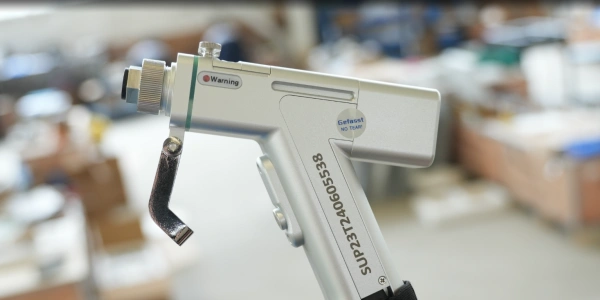
Most machines ship with factory presets organized by program number. Start there, then tune only what the job needs (LightWELD):
- Continuous wave vs pulsed. CW is the default and the fastest route to penetration and speed. Pulsed mode typically improves weld quality and significantly reduces heat input — it is the right choice for thin, heat-sensitive sheet, foils, and fine mesh. The trade-off is travel speed.
- Pulse length and frequency. Longer pulses weld faster but add heat; shorter pulses cut heat but slow you down. Higher frequency is faster but can increase spatter; lower frequency tends to look better and run slower.
- Power. More power means more penetration and speed, but also less control and a higher chance of piercing through thin material. Match power to your normal thickness, not the maximum you might one day cut.
- Wobble. Wobble length sets the seam width; wobble frequency sets the side-to-side speed. Use a faster frequency on thinner material and slower on thicker material to get fusion without burn-through.
- Wire feed. Wire size follows the bead you want; dual wire feeders exist for wider gaps and larger beads. Feed speed is dictated by your target travel speed.
Shielding gas is a separate decision and is driven by the material:
| Material | Typical shielding gas | Starting flow rate |
|---|---|---|
| Stainless steel | Nitrogen (argon for specific quality cases) | 15–25 L/min (≈32–53 CFH) |
| Mild and carbon steel | Nitrogen (argon if embrittlement appears) | 15–25 L/min (≈32–53 CFH) |
| Galvanized steel | Nitrogen; argon or argon/nitrogen mixes for specific cases | 15–25 L/min (≈32–53 CFH) |
| Aluminium | Argon (ultra-high purity if porosity appears) | 10–20 L/min (≈21–42 CFH) |
| Copper, nickel alloys, titanium | Argon | 10–20 L/min (≈21–42 CFH) |
Gas data above is from the same IPG/LightWELD parameter guide. Start at the low end and increase gradually if you see oxidation.
Materials and Joint Types You Can Expect to Weld
Fraunhofer IPK, which studies the process directly, describes handheld laser welding as suitable for unalloyed, low-alloy and high-alloy steels, weldable aluminium and nickel-based alloys, with titanium and copper alloys also processable. Typical joints are T-, overlap, and corner joints, with I-joints possible too (All-About-Industries, 2025).
The same source adds a warning worth repeating: “even a flawless surface can conceal defects.” IPK recommends embedding the process in proper development work — cross-sections, and X-ray testing where the application demands it — because the right parameters can reach the highest evaluation group, and the wrong ones can hide behind a clean-looking bead.
Safety and Qualification: Non-Negotiables
Laser radiation is the obvious hazard, and the controls are specific: laser safety goggles at all times, and work inside a demarcated area so nobody else is exposed to the beam — the same requirement Air Liquide’s welding expert stresses in the industry feature cited above. Fume extraction is the second item — laser welding on coated and galvanized material produces fumes that need capture at the torch.
On the qualification side, some European shops have gone as far as third-party certification of laser beam welding, and their operators credit training — not the machine — for the results. If you weld to a code, plan the welder qualification route before you take on the first laser job.
A 7-Step Trial Plan Before You Buy
Run this on your own parts, not on a demo plate:
- Pick your three most common jobs — the ones that currently cost you the most grinding or rework.
- Send the actual material, thickness, and joint design to the supplier — not a description of it.
- Ask for a welded sample you can section, plus the parameter sheet that produced it.
- Measure distortion on the thinnest part in the trial, where laser welding should win biggest.
- Time the full operation: weld plus any finishing. The savings usually come from the finishing step.
- Confirm consumables and spares lead time — protective lenses, nozzles, wire.
- Ask what training is included, and who you call when a parameter needs changing.
Handheld Laser Welding FAQ
Is handheld laser welding a replacement for TIG?
No. Air Liquide’s welding expert describes it as a complement to TIG and MAG rather than a replacement: handheld laser welding takes the thin, cosmetic, hard-to-reach work where speed and low distortion matter, while TIG remains the right choice for heavy sections and contaminated material. Most shops that adopt it keep both.
How much training does handheld laser welding require?
More than the sales material suggests. A TÜV-certified German fabricator put its specialists through intensive training, noting that hand-guided work depends on dexterity as much as on the equipment. Budget for training and for a period of supervised production before laser welding goes onto customer work.
Can handheld laser welding be used without filler wire?
Yes. The process can run autogenously, with the beam alone fusing the joint. Where fit-up leaves gaps or a larger bead is required, standard MIG wire is used, and dual wire feeders can be fitted to fill wider gaps and build larger beads.
Where does handheld laser welding add the most value?
Three places, in order of typical return: eliminating post-weld grinding and finishing on cosmetic stainless work; welding thin or heat-sensitive sheet without distortion; and handling complicated geometry or repair work that a robotic cell cannot reach economically.
Do I need to test welds made by handheld laser welding?
Yes, especially at the start. Fraunhofer IPK points out that a flawless surface can conceal internal defects, and recommends cross-section examination and, where the application requires it, X-ray testing. Once parameters are locked in, sampling can be reduced to a documented schedule.
Next Step for Your Shop
Handheld laser welding is a targeted capability: it wins on thin and cosmetic work, on awkward joints, and on small lots — and it asks for trained operators and clean fit-up in return. The fastest way to know which side of that line your work sits on is a trial on your own material.
If your bottleneck is finishing time on stainless parts, a handheld laser welding machine is usually the first machine to evaluate; for heavier and more repetitive fabrication, compare it against our fiber laser welding systems and the wider laser welder range. Tell us your material, thickness, and joint type, and we will send a parameter recommendation plus the sample-weld route. You can also see how these machines are applied by industry on our laser welding applications page.